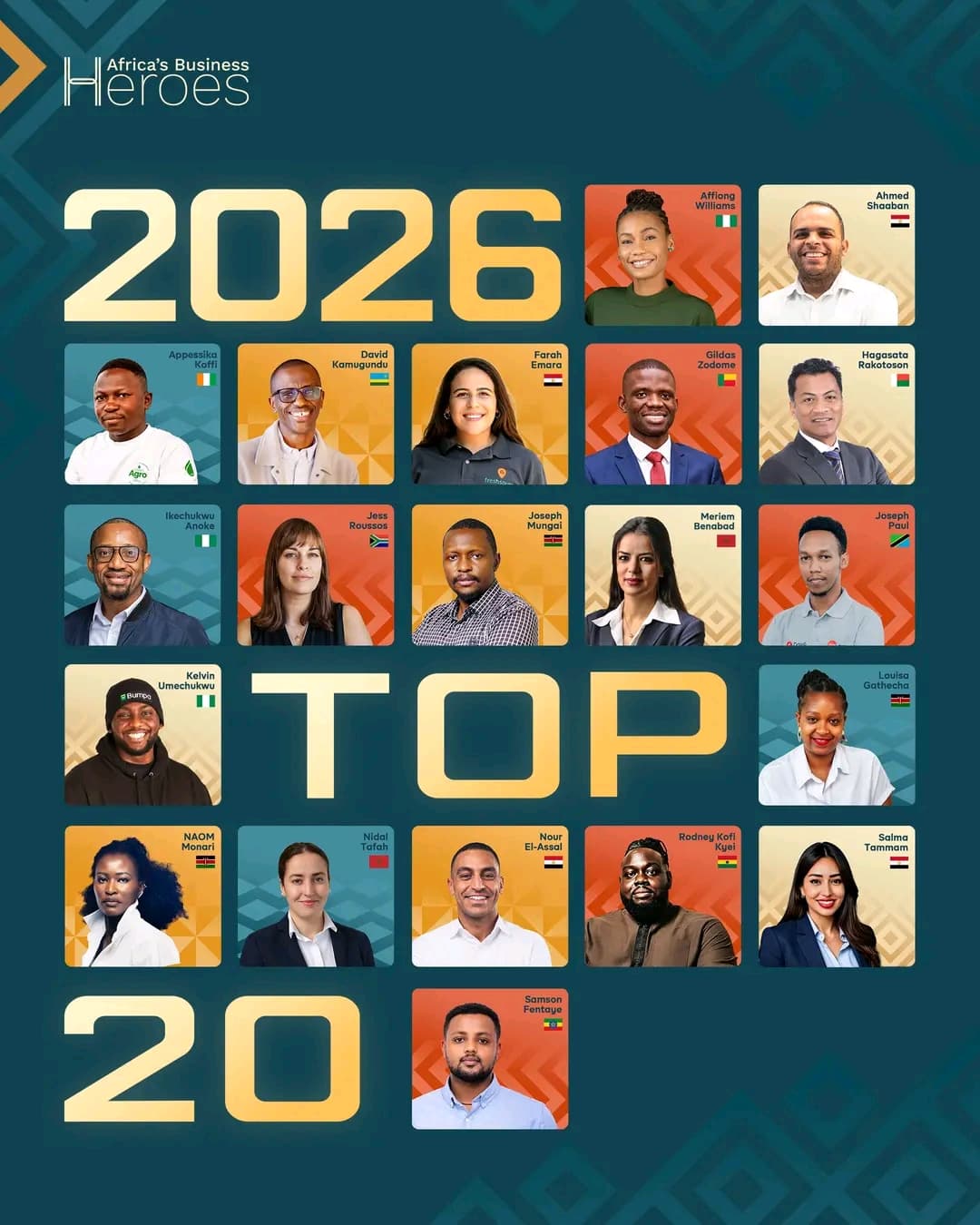
Nairobi August 20, 2026- Judges at the Africa’s Business Heroes (ABH) 2026 Semi-Final have challenged the continent’s Top 20 entrepreneurs to demonstrate strong business fundamentals, measurable impact and the ability to scale as they compete for 10 places in the Grand Finale.
The two-day semi-final, being held in Nairobi on August 21–22, brings together entrepreneurs selected from more than 24,000 applications received from all 54 African countries. The Top 20 represent 12 African countries and 11 sectors, with their businesses collectively generating approximately US$85 million in revenue in 2025.
The entrepreneurs advanced to the semi-final after passing through the competition’s expanded Top 100 stage, which included judging-panel interviews assessing leadership, innovation, impact, scalability and commercial strength. ABH also conducted on-the-ground visits and due diligence on the businesses that advanced to the semi-final.
Speaking ahead of the semi-final, Kome Oruade-Etim, Global Programme Manager for Acumen Angels and one of the judges, said entrepreneurs must demonstrate that their businesses are addressing problems that genuinely need to be solved.
Oruade-Etim said the judging process would go beyond assessing the founders’ personal vision to examine the actual impact their businesses can have on communities.
“When I’m backing a business, it’s not the impact relative to their own vision as a company, but what is the impact that they can actually make relative to the problem,” she said.
She said the entrepreneurs must also demonstrate sound business fundamentals and show that their solutions respond to real market needs.
“We expect nation for us, but the fundamentals of the business also matter,” Oruade-Etim said, stressing the importance of understanding the problem being addressed, whether customers need the solution and whether entrepreneurs understand their unit economics.
She added that entrepreneurs should have a clear understanding of their businesses’ end goals and demonstrate how partnerships with governments and other institutions could help them achieve greater impact.
Wandia Gichuru, Co-Founder and CEO of Vivo Fashion Group and a semi-final judge, urged the entrepreneurs to approach their pitches with confidence and clarity, noting that the question-and-answer session would be particularly important.
“The pitch is very short, but the real meat is in the questions,” Gichuru said, encouraging the entrepreneurs to prepare for questions from the judges and demonstrate a strong understanding of their businesses.
She also encouraged the finalists to remain true to themselves, saying their selection among more than 24,000 applicants was already a significant achievement.
Gichuru further urged the entrepreneurs to demonstrate how their businesses can create opportunities for others as they grow, arguing that successful enterprises should generate impact beyond their immediate operations.
Among the Top 20 is Jess Roussos, Co-Founder and Co-CEO of South Africa-based BluLever Education, a company providing technical and vocational training linked closely to industry needs.
Roussos said BluLever combines technical training with soft skills and business skills after research showed that employers value teamwork, communication and problem-solving alongside technical competence.
She said the company works continuously with industry to understand employers’ needs and update its curriculum accordingly.
Roussos also highlighted challenges facing traditional technical and vocational education and training (TVET) systems, including weaknesses in funding and relationships between colleges and employers.
According to Roussos, employers should be treated as customers because they ultimately require the skills produced by the training system.
“Our employers are our customers. Our young people are not our customers; they are our product,” she said, adding that BluLever works closely with employers to understand their needs.
The company, which began in Johannesburg with a focus on plumbing, has expanded into automation, electrical and other trades. It plans to open a new campus in Cape Town and is exploring a third campus in Nairobi as demand for its services grows.
Another Top 20 entrepreneur, Joseph Paul of Tanzania-based Dawa Mkononi, is using technology to improve access to medicines by connecting hospitals, pharmacies and communities.
Paul said the company aims to create a platform where hospitals, pharmacies and other healthcare providers can order medicines and have them delivered to improve access to essential drugs.
He said Dawa Mkononi plans to expand into Uganda, Zambia, Kenya and Ethiopia while promoting digital literacy to help communities use mobile phones and digital applications more effectively.
At the end of the Nairobi semi-final, 10 entrepreneurs will be selected to advance to the next stage and compete at the ABH Grand Finale in Kigali, Rwanda, in December.
The Nairobi event is also expected to connect the entrepreneurs with investors, business leaders, universities and other ecosystem partners, creating opportunities for access to capital, markets and strategic partnerships.