Africa has made significant gains in agricultural production and built stronger food systems over the past two decades, but the progress has not translated into sufficient incomes and prosperity for farmers, the Alliance for a Green Revolution in Africa (AGRA) has acknowledged.
A new 20-year review by AGRA warns that the continent is still not moving fast enough to achieve its agricultural transformation ambitions by 2035, with productivity, weak value chains and limited institutional capacity continuing to hold farmers back.
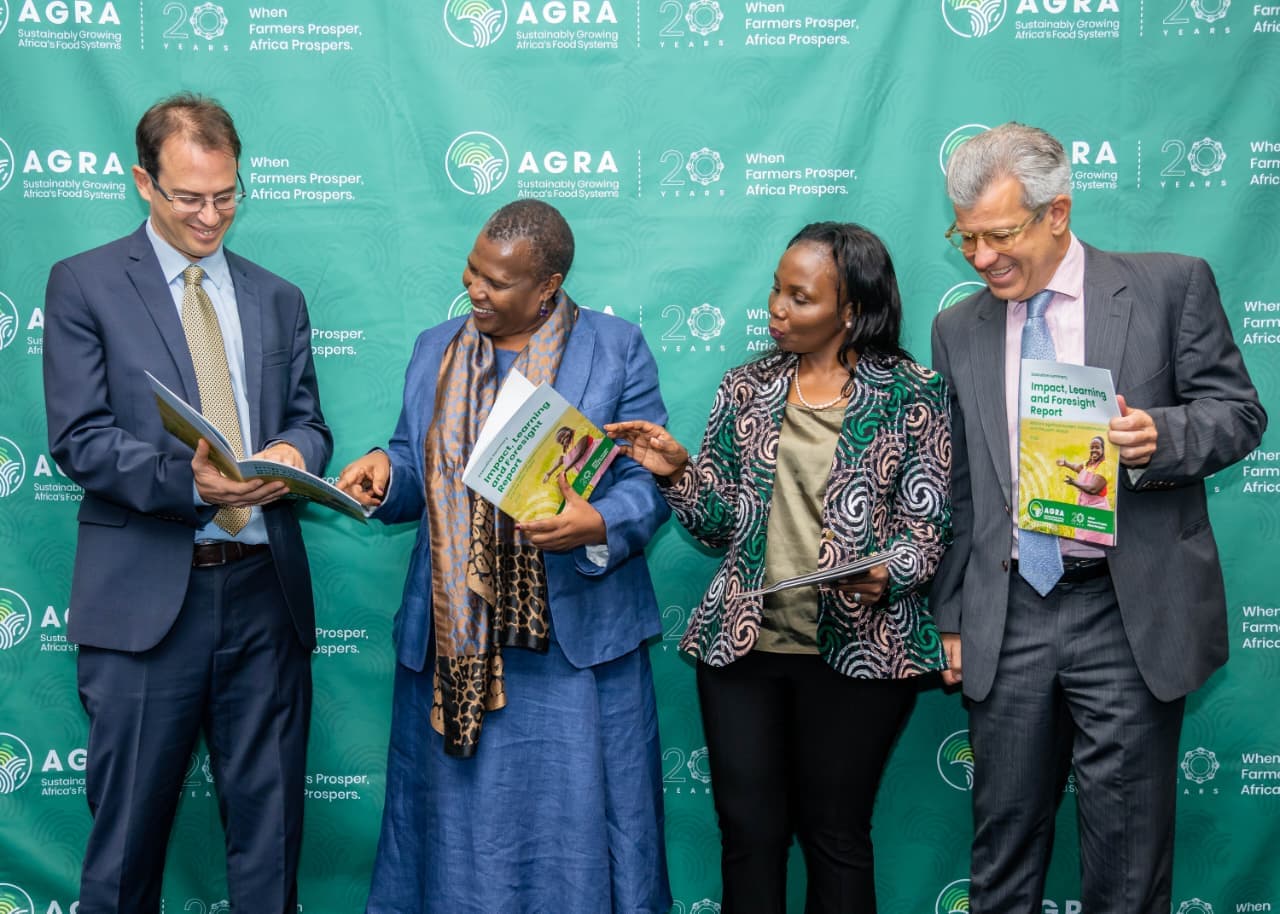
The Impact, Learning and Foresight Report, launched in Nairobi on Monday, shows that farmer incomes have doubled, cereal yields have risen by about 40 per cent and farm output has roughly doubled in real terms since 2005.
However, AGRA says these gains remain uneven and insufficient, with farmer incomes still below global averages, persistent productivity gaps and rising hunger undermining the continent's progress.
AGRA President Alice Ruhweza said the central measure of agricultural transformation should be whether farmers are actually becoming more prosperous.
“When farmers prosper, Africa prospers,” Ruhweza said, noting that farmers need more than higher yields to improve their livelihoods.
She said reliable productivity must be accompanied by functioning markets, fair value, access to finance, knowledge, infrastructure, healthy soils and policies that translate into actual delivery.
“If productivity increases but value is lost, farmers remain poor,” she said.
The assessment marks a significant shift in emphasis for AGRA, which was established in 2006 to support the African Union's agricultural transformation agenda.
Ruhweza said the organisation's 20-year experience had demonstrated that Africa had moved considerably from the conditions of the 1980s and 1990s, when recurring crop failures, food shortages, weak extension systems and limited agricultural investment constrained smallholder farmers.
She said the 2003 Maputo Declaration marked a turning point by establishing a continent-wide commitment to agricultural transformation.
Since then, local seed industries have expanded, agro-dealer and extension networks have grown, and governments and private-sector actors have developed greater capacity to support farmers.
AGRA and its partners have supported 118 seed companies, more than 650 improved seed varieties, over 25,000 agro-dealers, 33,000 community extensionists, five million farmers trained in soil health and climate-smart practices and nearly 800 scientists.
The organisation also says it helped leverage approximately 691 million US dollars for national agricultural investment plans.
But AGRA's leadership cautioned that these interventions have not yet produced transformation at the scale required.
The report identifies three interconnected challenges facing Africa's food systems: the productivity trap, the value trap and the capability trap.
The productivity trap limits farmers' ability to produce reliably and withstand climate and resource pressures. The value trap means farmers can increase production without capturing enough income from markets, processing and trade, while the capability trap reflects weaknesses in institutions, finance, data, coordination and accountability.
Andrew Cox, AGRA's Director of Strategy, Monitoring and Evaluation and Learning, said growing pressure on soils and water, alongside climate volatility, was making the challenge more urgent.
He said the continent needed to move beyond focusing primarily on connecting farmers to inputs and agricultural research and instead strengthen the link between farmers and consumers.
Farmers, he said, need stronger connections to local markets, supermarkets, expanding cities and export markets so that increased production can translate into better prices and incomes.
The organisation also wants greater private investment in agriculture, arguing that Africa's growing urban population and food markets provide a major investment opportunity.
Jonathan Said said AGRA's future approach would focus more on helping countries identify the specific constraints preventing agricultural transformation and bringing different actors together to address them.
He said governments and local institutions should remain in the driving seat, with AGRA providing catalytic support rather than attempting to lead the entire agricultural system.
“The ecosystem of support is growing,” Said said, pointing to private-sector companies, technology firms, processors, non-profit organisations and other actors increasingly operating across the food system.
AGRA intends to focus on diagnosing binding constraints, coordinating actors, strengthening local institutional capacity and ensuring that evidence and data inform policy and investment decisions.
The organisation also acknowledged that agricultural policy has improved in many African countries since the 1990s, but implementation remains a major weakness.
Said said governments had made progress in developing policies capable of unlocking agricultural transformation but had been less successful in implementing them effectively.
Ruhweza said AGRA would therefore become more focused on evidence, more transparent about what had not worked and more accountable for outcomes.
She said the organisation would measure success not simply by the number of farmers reached or programmes implemented, but by whether farmers' incomes, resilience, dignity and opportunities improve.
The report warns that Africa's current agricultural trajectory will not deliver the targets contained in the Kampala Declaration and the third Comprehensive Africa Agriculture Development Programme (CAADP 3.0) by 2035.
AGRA says achieving those targets will require a more integrated approach involving governments, farmers, businesses, financiers, researchers, development partners and civil society.
The organisation argues that agriculture can no longer be treated as the responsibility of agricultural ministries and development agencies alone, as farmer prosperity is also determined by decisions involving finance, trade, infrastructure, energy, water, climate, health, education, science and industry.
AGRA Board Chair H.E. Hailemariam Dessalegn said agricultural progress would only amount to transformation if productivity gains were accompanied by stronger value retention and lasting institutional capacity.
“Progress becomes transformation only when productivity is restored, value is retained and capability is sustained,” Dessalegn said.
Ruhweza also called on the media to change the way agriculture is covered, arguing that the sector should not be presented as a story of the past but as one of the continent's most important economic opportunities.
She said Africa's agricultural sector has the potential to create jobs, strengthen food security, support manufacturing, improve climate resilience and reduce dependence on food imports if the systems surrounding farmers are strengthened.
The report does not claim that AGRA alone transformed African agriculture, instead describing the organisation as one contributor among governments, farmers, businesses, researchers, financiers and development partners.
Ruhweza said the review was intended as a candid assessment of AGRA's contribution, including areas where progress had been limited or fragile.
She said the next decade should therefore focus less on isolated projects and more on building systems capable of converting agricultural productivity into sustained prosperity.
The findings will now be taken to the Africa Food Systems Forum in Kigali, Rwanda, where AGRA and other stakeholders are expected to discuss how the continent can accelerate implementation of its agricultural transformation agenda.