The Government of Kenya has launched the ChildSAFE Kenya Project, a new initiative aimed at strengthening child protection systems, promoting early childhood development and preventing unnecessary separation of children from their families.
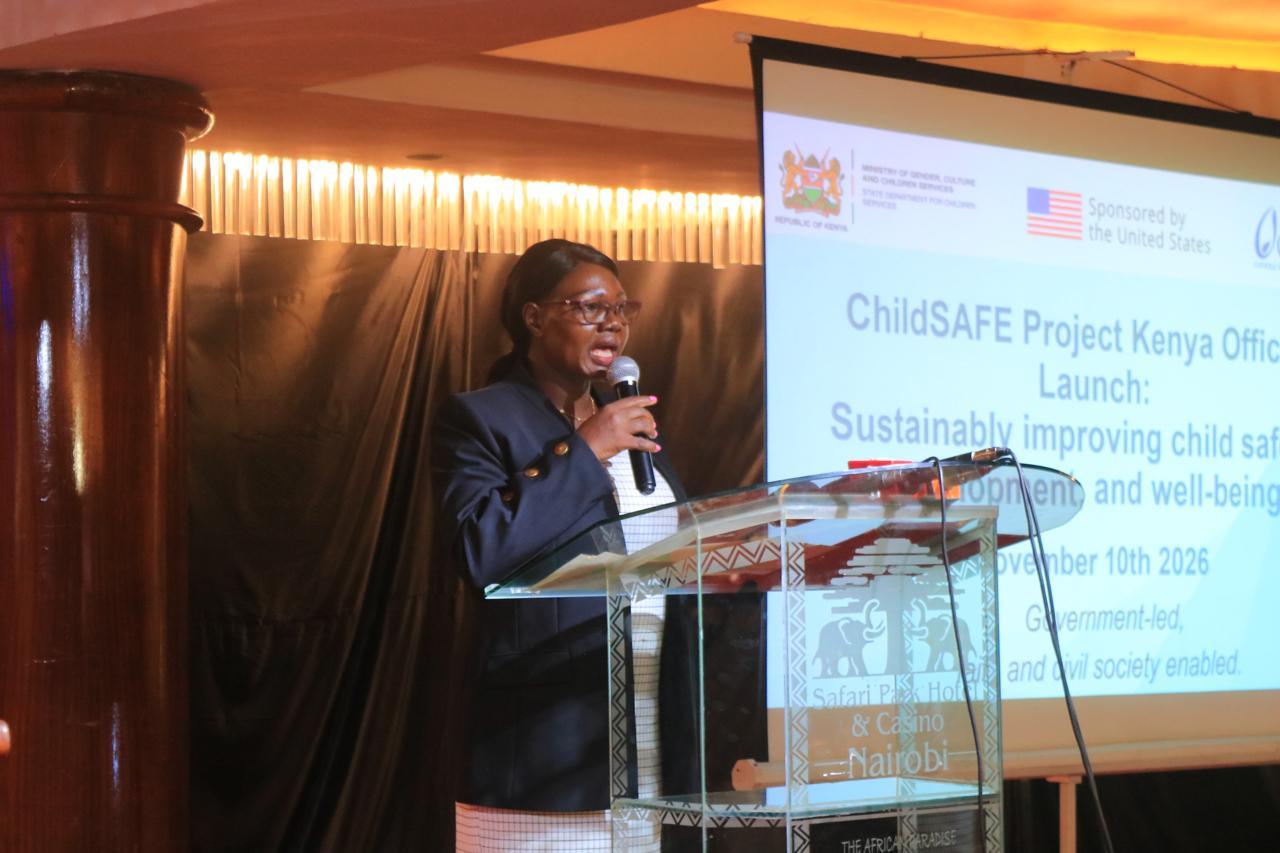
The project, officially launched on Tuesday, November 10, 2026, at Safari Park Hotel in Nairobi, brings together the Government, Catholic Relief Services (CRS), the United States Government and other development partners in a coordinated effort to improve the safety, protection and well-being of children across the country.
Speaking during the launch, Principal Secretary for Children Services CPA Carren Ageng’o said the initiative would reinforce the government's commitment to ensuring that every child grows up in a safe, nurturing and supportive environment.
Ageng’o noted that the project comes at a critical time when the Government is strengthening national and county-level child protection systems and implementing reforms aimed at improving care for vulnerable children.
"ChildSAFE Kenya comes at an opportune time as Government strengthens national and county-level systems for child protection. We therefore welcome ChildSAFE Kenya as a strategic partner in advancing our national priorities on child protection, early childhood development and care reform," she said.
She reaffirmed the Government's commitment to working with development partners, noting that the initiative aligns with the mandate and strategic priorities of the State Department for Children Services.
The project, supported by the United States Department of State through the Bureau of Global Health Security and Diplomacy and implemented by CRS alongside its partners, will focus on three priority areas: strengthening child protection systems and referral pathways, promoting integrated early childhood development and nurturing care, and preventing unnecessary family separation through family strengthening and alternative family-based care.
According to Ageng’o, the initiative will be implemented at national, county and community levels, with targeted interventions in Kisumu, Kakamega, Nairobi, Kajiado, Mombasa and Kilifi counties.
It will benefit children, families, caregivers, community structures, social service workers and other duty bearers, with particular attention given to vulnerable and at-risk children and families.
The Principal Secretary said the project would address several challenges affecting children, including violence, neglect, abuse, exploitation and unnecessary separation from their families.
Other interventions will include strengthening family-based and alternative care, promoting early childhood development, providing psychosocial support and improving referral services.
She observed that effective child protection requires investment in families, institutions and community structures rather than concentrating exclusively on individual interventions.
"The approach is informed by the understanding that children's well-being is inseparable from the well-being of their families and the strength of the family support systems. We must therefore invest in strong institutions, empowered families, capable social service workforces and effective community structures," Ageng’o said.
She further highlighted the importance of strengthening existing government reporting and case management platforms, including the Child Protection Information Management System (CPIMS), VuruguMapper and Child Helpline 116.
According to her, these platforms are critical in facilitating timely reporting, referrals, case management and responses to child protection concerns.
"We look forward to the Project enhancing their functionality, improving data quality and strengthening the use of information for evidence-based planning and decision-making," she said.
However, Ageng’o emphasized that the use of digital platforms must be accompanied by strong safeguards to protect children's personal information.
She said confidentiality, dignity and the best interests of children must remain paramount in accordance with the Data Protection Act, 2019.
The Principal Secretary also challenged implementing partners to ensure the initiative operates under government leadership, warning against the creation of parallel systems that could undermine existing institutions.
"Our partnership should reinforce existing institutional capacities, complement ongoing programmes and promote coordinated service delivery, while avoiding duplication and parallel systems. Above all, we must prioritize sustainability to ensure that the capacities, systems and gains achieved through the Project are maintained beyond its implementation period," she said.
She identified coordination and accountability, workforce capacity, early childhood development, family strengthening, care reform and sustainability as key expectations for successful implementation.
On care reform, Ageng’o called for increased efforts to promote family-based care and the safe reintegration of children living in residential care institutions into families and communities, guided by the Children Act, 2022, the National Care Policy, 2025 and the National Care Reform Strategy 2022–2032.
She reaffirmed that the State Department for Children Services would provide policy and technical leadership throughout the implementation of the initiative.
Meanwhile, Catholic Relief Services Country Manager Margaret Kahiga said the launch marked an important milestone in strengthening collective efforts to ensure children in Kenya grow up safe, protected, nurtured and able to realize their full potential.
Kahiga expressed appreciation to the Government of Kenya, particularly the State Department for Children Services, for its leadership and commitment to advancing children's rights and welfare.
She also acknowledged the United States Government for providing financial support towards the initiative, which is being implemented in nine countries, including Kenya.
"The theme of today's launch speaks powerfully to our shared aspiration: sustainably improving child safety, development, and well-being through a government-led and faith and civil society-enabled approach," Kahiga said.
She emphasized that protecting children should not be left to one institution, noting that sustainable interventions require collaboration among government agencies, families, communities, faith leaders, development partners and children themselves.
According to Kahiga, although Kenya has made significant progress in strengthening child protection systems and promoting family and community-based care, many children continue to face risks associated with poverty, violence, neglect, abuse, harmful practices and family separation.
She said these challenges require comprehensive and sustainable solutions that are locally owned and supported by strong institutions.
"Rather than focusing solely on individual interventions, ChildSAFE seeks to strengthen the systems that protect children every day. It aims to enhance child protection systems, support early childhood development, strengthen families, and promote safe and appropriate alternative care where needed," she said.
Kahiga noted that the initiative places government leadership at the centre of implementation, adding that sustainable progress can only be achieved when national and county institutions have the capacity, resources and partnerships necessary to lead interventions.
She further underscored the role of faith-based organizations in protecting children, noting that churches, mosques and other religious institutions remain important community spaces where families seek guidance, support and assistance.
"Faith leaders often serve as advocates for children's rights and champions of positive social norms. Through ChildSAFE, we have a tremendous opportunity to further harness these strengths to create safer environments for children," she said.
The CRS Country Manager also called for children's voices to remain central in decisions affecting their welfare, emphasizing that their experiences, aspirations and perspectives should inform the systems and partnerships established to protect them.
She said the success of the initiative should not be measured merely by the number of activities completed or targets achieved, but by the actual improvements in children's lives.
"Success will be measured by children who grow up free from violence and exploitation; by families that are equipped to provide nurturing care; by communities that protect their most vulnerable members; and by systems that consistently uphold the rights and dignity of every child," Kahiga said.
She urged stakeholders to deepen collaboration and invest in sustainable interventions that place children's welfare at the centre of development efforts.
The launch marks a renewed partnership between the Government and development actors in strengthening child protection mechanisms, improving family support systems and ensuring vulnerable children have access to appropriate care and protection.
Through ChildSAFE Kenya, stakeholders are expected to generate evidence and document successful interventions from the six priority counties to inform national policies, resource allocation and the continuous improvement of child protection services.
The initiative seeks to build stronger institutions, empowered families and safer communities while ensuring that every child in Kenya has an opportunity to grow, develop and realize their full potential.